The GRIP-EMS Guide
Most rotation problems come down to a few settings and a handful of habits. This guide covers them.
Written by a player who runs GRIP-EMS through Mythic+ and validates his own sequences against Warcraft Logs before publishing them. This is not a feature tour and it is not a rehash of the official documentation. It is a practical guide to making the addon work correctly from the first install through your first validated sequence, written for players of every class and spec.
If your keybind is set but nothing is firing, go straight to Installation. On v2.3.14 and later this is rarely the cause since Key Down Casting is handled for you, but on older versions the Cvar Health fix takes thirty seconds and solves that problem the majority of the time. And if GRIP-EMS is missing from your AddOns list altogether after a game patch, update it before you do anything else, because an addon that does not name the current patch will not load; the 12.1.5 fix arrived in v2.4.20-hotfix and is in every release since. If you are coming from an older macro sequencing addon and want to know whether switching is worth it, start with Coming from GSE.
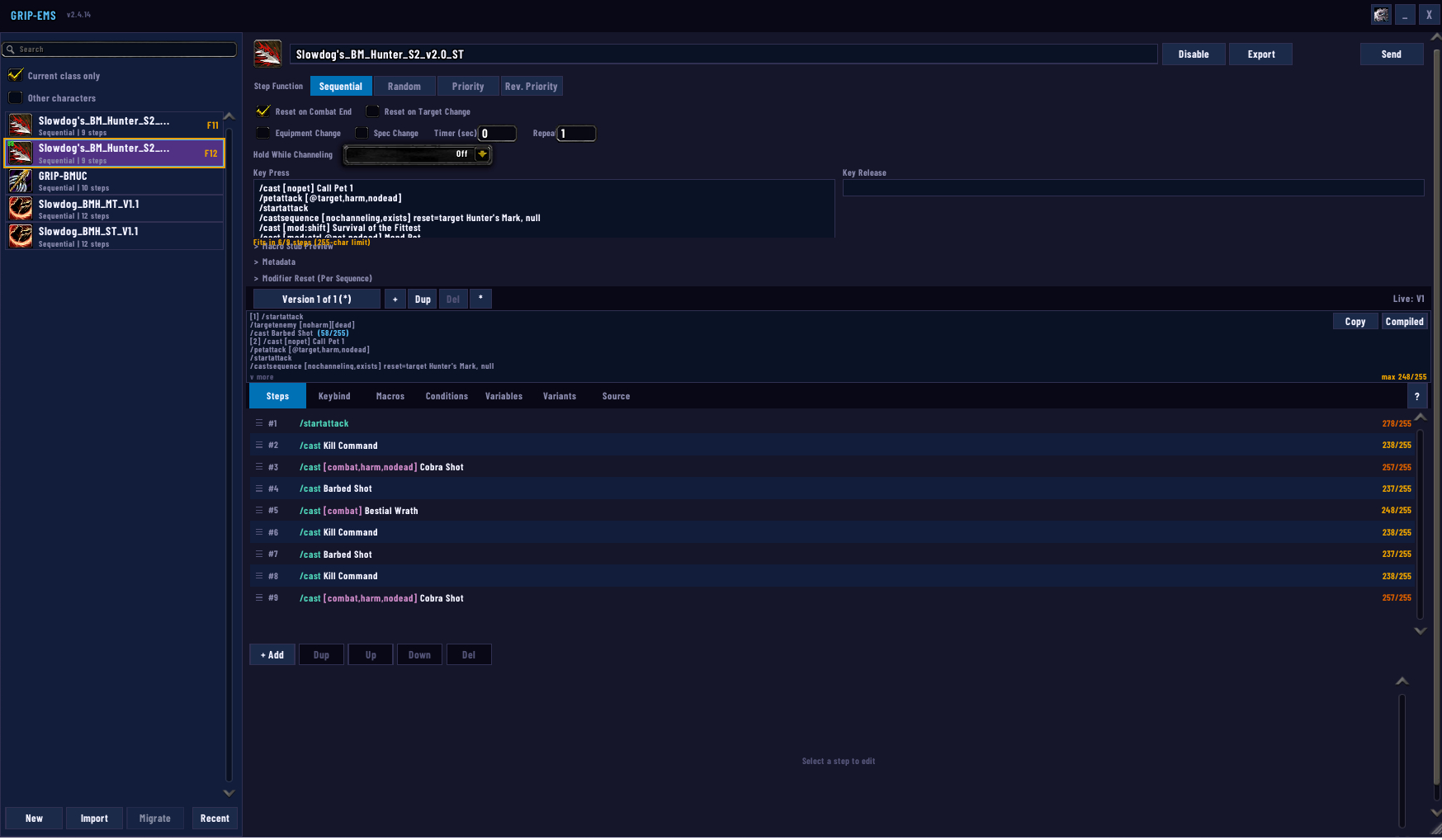
The GRIP-EMS editor, mid-sequence. Every screenshot in this guide is pulled from a real character, not a mockup.
Download, enable, and check the few settings that decide whether a keybind fires. As of v2.3.14, Key Down Casting is handled for you. If your keybind is set but nothing fires, start here.
The in-game settings that determine whether your sequences run smoothly or feel broken. Key Down Casting, Spell Queue Window, the Dynamic SQW Optimiser, click rate and Auto-adjust, and how the Tempo Advisor fits them together.
What GRIP-EMS actually does under the hood, why WoW's secure execution environment matters for sequence design, and the mental model you need before you build anything. Getting this wrong is what produces sequences that feel fine on dummies and fall apart in real content.
A reference for the rest of what GRIP-EMS does: Pause, reset conditions, skyriding, context versions and per-loadout keybinds, keybind recovery, Interleave, the plugin API for building your own addon against GRIP-EMS, imports, the display layer, and sharing sequences.
The decision framework behind sequence design, applied to a real Guardian Druid Mythic+ sequence and a generic DPS build. Not what the buttons do but why the structure is what it is, what breaks if you change it, and how to apply the same thinking to your own spec.
Written specifically for players who use GSE and are evaluating whether to switch. The one mechanical difference that actually matters, what transfers automatically, and the practical steps to get your existing sequences running.
How to know your sequence is actually working for any spec. Warcraft Logs CSV exports as the proof standard, not gut feel and not dummy parsing. Includes how to use the built-in Repair module as a first-pass diagnostic before you ever open a log.
What Blizzard has actually put in writing about addons, macros and one keypress doing one thing, what it has never ruled on, and what Midnight changed. Sourced and dated, and it does not claim GRIP-EMS is approved, because nobody at Blizzard has said that.
Whether GRIP-EMS runs on Blizzard's Classic+ expansion, what Sataana has confirmed so far, where the beta's early SavedVariables bug stands now that a fix build has been reported, and what Blizzard has said about addons there. Updated as the beta moves.
Every GRIP-EMS release since the first beta, in Sataana's own words, with a picker that shows what you missed since your version.
Before you open the editor
The single biggest mistake new users make is opening GRIP-EMS and typing spell names before they know what their sequence is supposed to do. The addon executes a rotation you have already designed, it does not design it for you. Sitting down with no plan produces a sequence that technically runs but delivers mediocre results because the step ordering and spacing came from guessing rather than understanding your spec.
Before you build anything, spend twenty minutes with the Icy Veins guide or your spec Discord and answer four questions. What is your highest priority spell and how often does it need to fire? What is the cooldown you cannot afford to miss on pull? Which spells can be skipped when unavailable without breaking the rotation, and which ones cannot be skipped? And do you need the sequence to behave differently in different content, such as a different opener for Mythic+ versus raid?
The answers to those questions determine your step count, your step function choice, your reset conditions, and whether you need context versions. The Building sequences section walks through exactly how those answers translate into a working sequence for any spec.
About the sequences on this site
Sequences on LazyGrip can list the content type they were validated at, the key level or difficulty tier, and the talent string they were built for, and many do not. If a sequence does not list validation data, treat it as a starting point to adapt rather than a finished product to import and run blind. A sequence validated at plus 10 on one hero talent path will produce different numbers on a different path because the spells and their interactions differ.
A talent string is listed with a sequence for exactly this reason when its author includes one. If your talents do not match, the sequence is still worth importing as a structural reference, but plan on a validation pass before you rely on it in serious content.